Small Shop Diwali Sales Tips 2026: Beat Quick Commerce
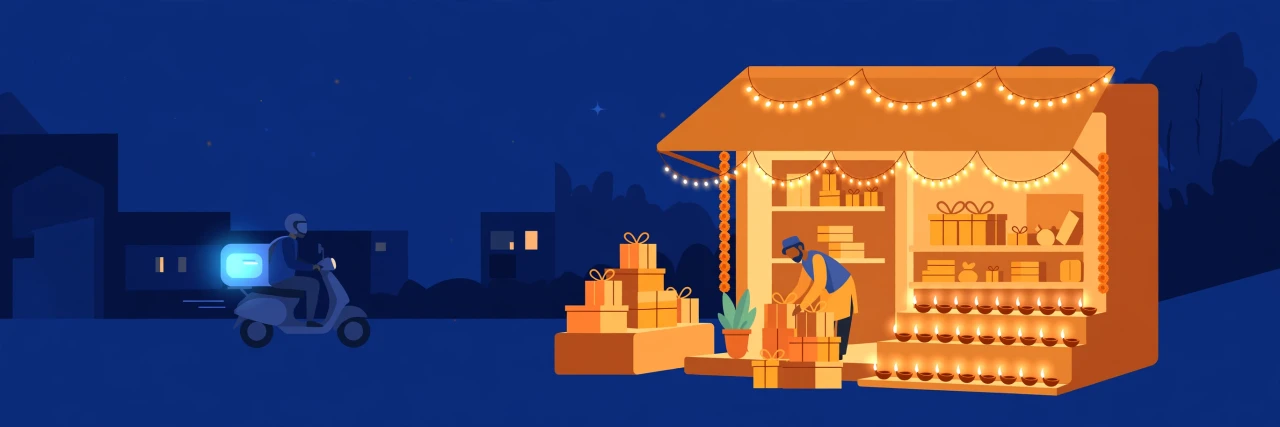
Two evenings before Dhanteras, a décor shop owner in Jaipur watches a customer pick up clay diyas, hesitate, check her phone, put them back — and walk out. Ten minutes later, a delivery rider stops two doors down with a bag of diyas from a quick-commerce app.
She has just watched her sale drive away on a scooter.
If small shop Diwali sales tips 2026 is what you're searching for, this is the exact battle you're fighting. Not the big planned purchases — those were decided weeks ago. The battle is the last-minute wallet: the diyas someone forgot at 6 PM, the gift box needed tomorrow morning. And that battle is winnable — quick commerce has weaknesses a neighbourhood shop can exploit.
In this post
- Why Diwali 2026 is different: the two-speed pattern
- What quick commerce actually steals from your shop
- What a 15% last-minute leakage costs you in rupees
- Small shop Diwali sales tips 2026: the 5 counter-moves
- Which counter-move fits your shop: a decision table
- Copy-paste: your Diwali-week shop message
- Frequently asked questions
Why Diwali 2026 is different: the two-speed pattern
This year's Diwali is unusually late — an Adhik Maas year. The festival has shifted deep into November: Dhanteras November 6, Diwali November 8, Bhai Dooj November 11. That quirk stretched the shopping season — and split it in two.
An analysis by entri.app, published October 5, describes festive buying in India as now running at two speeds. Speed one is planned and early: big-ticket purchases — the TV, the appliance, the gold — were bought during the early-October marketplace sales, weeks before the festival. Speed two is last-minute and emotional: the small-ticket items — diyas, mithai, flowers, gift boxes — bought in a rush when someone realises they're missing something. The "forgot the diyas at 6 PM" purchase.
That second speed now belongs largely to quick commerce: its festive demand peaks in the final week — which is exactly where we are. The customer who would once have rushed to the nearest market at 7 PM now taps an app at 7:05.
The takeaway: you cannot win back the planned big-ticket sale. But the last-minute sale is still in play — within a few kilometres of your shutter.
What quick commerce actually steals from your shop
Here's the part most shop owners misread. Quick commerce is not stealing your most expensive inventory. It's stealing your most profitable one: the impulse, high-margin, no-discount-needed goods — diya sets, candles, rangoli colours, fairy lights, gift boxes, mithai. A ₹40 diya set carries a far better margin than a discounted appliance, and needs no bargaining or EMI.
Losing these sales hurts twice. First, the margin itself. Second, the footfall: the customer who walks in for diyas also buys the mithai box and the gift wrap. The app customer buys only what they searched for. Every last-minute customer you lose to an app is a basket you never got to build.
Why do they win these orders? Three honest reasons: the app is open when your shop is closed, the delivery removes the trip, and the price is visible upfront. All three are answerable — which is what the five counter-moves below do.
What a 15% last-minute leakage costs you in rupees
Some illustrative numbers, so the counter-moves have a budget. Take a small festive shop doing roughly ₹2 lakh of turnover in Diwali week, with about half — ₹1 lakh — from last-minute and top-up purchases.
If quick commerce captures 15% of that last-minute wallet — an illustrative figure, not a measured one — that's ₹15,000 of revenue walking out the door in a single week. The lost profit on that ₹15,000 is the real wound, plus every add-on item those customers would have picked up in person.
Now flip it: win back even half of that leakage — ₹7,500 a week — with moves that cost almost nothing to run, and the effort pays for itself several times over.
Small shop Diwali sales tips 2026: the 5 counter-moves
None of these needs an app or ad spend. A single shopkeeper can start them this week.
Move 1: Stay open for the 6 PM diya run
Stay open till 9:30 PM from November 1 through November 8, and light the shop properly — a brightly lit shop on a dark lane is advertising you don't pay for. The customer choosing between a 10-minute app delivery and a 5-minute walk will take the walk if the shop is visibly open.
Move 2: Same-evening local delivery
Quick commerce's edge is delivery, not the product. Match the edge, not the app. Take orders by phone call or WhatsApp and deliver within 2–3 km the same evening — your own helper, your own vehicle.
Keep the rule dead simple: free delivery above ₹500, ₹30 below it. Say it on the signboard and in every message. You don't need 10 minutes. You need "tonight," said clearly.
Move 3: Pre-packed gift kits
Decision fatigue kills festive sales. A customer staring at forty loose items buys nothing; a customer shown three ready kits buys one.
Build three finished kits with big visible price tags:
- ₹499 — diya set + small mithai box + greeting card
- ₹999 — fairy lights + rangoli set + mithai box + card
- ₹1,999 — premium hamper with dry fruits, candles, and a keepsake diya
The ₹999 kit is your hero — the "respectable gift" price most buyers have in mind. And if offices nearby buy in bulk, offer a simple printed invoice for 10+ kits; for quick invoice templates that work from a phone, this invoicing automation roundup (5 AI Tools to Automate Invoicing and Follow-ups) covers free options.
Move 4: Curated in-store bundling
Kits are for gifting; bundles are for the shopper buying for their own home. Put a small "staff picks" table near the counter: the "6 PM combo" — diya set + rangoli colours + one fairy-light string at a single bundle price, slightly below the sum of parts.
Bundles lift the average bill — the customer came for diyas and leaves with lights — and no app can replicate curation in 10 minutes.
Move 5: A ready WhatsApp catalogue
Most last-minute buyers message first and visit second: "Do you have diya sets? How much?" If your answer takes an hour, the app has already won. A WhatsApp Business catalogue with your kits and combos — a photo and a price on every item — turns that question into an order in minutes.
The free WhatsApp Business app's catalogue feature is enough for a single shop. (Step-by-step setup, including photo sizes, is covered on our sister publication WhatsApp Business Playbooks.) To handle messages without living on your phone, the free tools in this small-business AI roundup (Best AI Tools for Small Business in India) include options for quick replies and cataloguing help.
Which counter-move fits your shop: a decision table
Not every shop should run all five. Match the move to what you can actually staff this week.
| Counter-move | Cost to start | Time per day | Best for |
|---|---|---|---|
| Extended evening hours (till 9:30 PM) | Near zero — one staffer or family member | 2–3 extra hours | Any shop on a residential lane |
| Same-evening local delivery | Near zero — your own helper/vehicle | 1–2 hours of delivery rounds | Dense neighbourhoods, 2–3 km radius |
| Pre-packed gift kits | Cost of packing material + display space | Half a day to assemble once | Shops with gifting stock |
| Curated in-store bundling | Zero — rearranges existing stock | 1 hour to set up the table | Décor/gift/general stores with walk-ins |
| WhatsApp catalogue | Zero — free app feature | 2–3 hours to photograph and list once | Any shop customers already message |
If you can only do two: evening hours plus the WhatsApp catalogue — one captures the walk-in, the other the message-first buyer.
Copy-paste: your Diwali-week shop message
Post this on your WhatsApp status and send it as one broadcast on November 1. Replace the bracketed bits.
🪔 [Shop name], [area] — OPEN till 9:30 PM all Diwali week. Diya sets, rangoli colours, fairy lights & ready gift kits from ₹499. Same-evening delivery within 3 km — just reply with your list. Wishing you a bright Diwali! ✨
One message, one broadcast, no daily spam. Customers forgive a single festive announcement; they mute a shop that sends five.
Frequently asked questions
Why is Diwali shopping different in 2026 (the "two-speed" pattern)? The festival falls unusually late (Dhanteras November 6, Diwali November 8, Bhai Dooj November 11 — an Adhik Maas year), so the season stretched and split. Big-ticket planned purchases happened in the early-October online sales; small-ticket last-minute buying now flows to quick commerce, which peaks in the final week.
How do quick commerce apps hurt local shops during Diwali week? They capture last-minute, high-margin impulse purchases — diyas, mithai, gift boxes, fairy lights — because they're open late, deliver in minutes, and show prices upfront. You lose both the margin and the add-on basket the walk-in customer would have built.
What can a local shop do about last-minute quick-commerce shoppers? Stay open till 9:30 PM through November 8, offer same-evening delivery within 2–3 km, sell pre-packed gift kits at clear prices, bundle curated in-store combos, and keep a WhatsApp catalogue with photos and prices.
Do extended evening hours actually move Diwali-week sales? They target the exact moment quick commerce wins — the after-6 PM "forgot the diyas" purchase, when most local shops are closed. A visibly lit, open shop converts the customer choosing between a 10-minute wait and a 5-minute walk.
How should a small shop package gifts to beat online delivery? Sell finished kits, not loose items: three clear price points (₹499, ₹999, ₹1,999), big visible price tags, ready to hand over. Curation and instant handover beat next-day gift wrap.
Can a local shop offer delivery that rivals quick commerce? It doesn't need to match 10 minutes — it needs to promise "tonight," clearly. Free delivery above ₹500 and a small ₹30 fee below, within 2–3 km, handled by your own helper on phone/WhatsApp orders, covers nearly every last-minute festive need nearby.
The two-speed Diwali isn't going away — next year the dates move, but the pattern of planned-online plus last-minute-instant will stay. The shops that win won't have the most stock. They'll be open when the customer remembers, reachable when the customer messages, and ready when the customer walks in.


Comments
Post a Comment